WHY CHOOSE HEFENG PORTABLE AIR CONDITIONERS?
In industrial environments, high temperatures are among the challenges that directly affect working conditions and plant operations. Especially in areas with heat-intensive machinery, continuously running production lines or scattered workstations, maintaining suitable temperatures is a concern for many businesses.
In industrial environments, high temperatures are among the challenges that directly affect working conditions and plant operations. Especially in areas with heat-intensive machinery, continuously running production lines or scattered workstations, maintaining suitable temperatures is a concern for many businesses.
However, not every workshop is suitable for a fixed air-conditioning system. For large spaces, frequently changing production areas or locations that only need spot cooling, businesses need a solution that delivers cooling capacity while remaining flexible in use.
Rather than looking only for a unit that produces cold air, businesses should consider factors such as cooling capacity, airflow, air distribution, placement flexibility and suitability for the actual environment.
HEFENG industrial portable air conditioners are a solution worth considering, offering multiple capacity levels, a flexible air duct system and R410A refrigerant cooling technology.
So what sets HEFENG portable air conditioners apart? What helps them meet cooling needs in industrial environments? Read on to find out.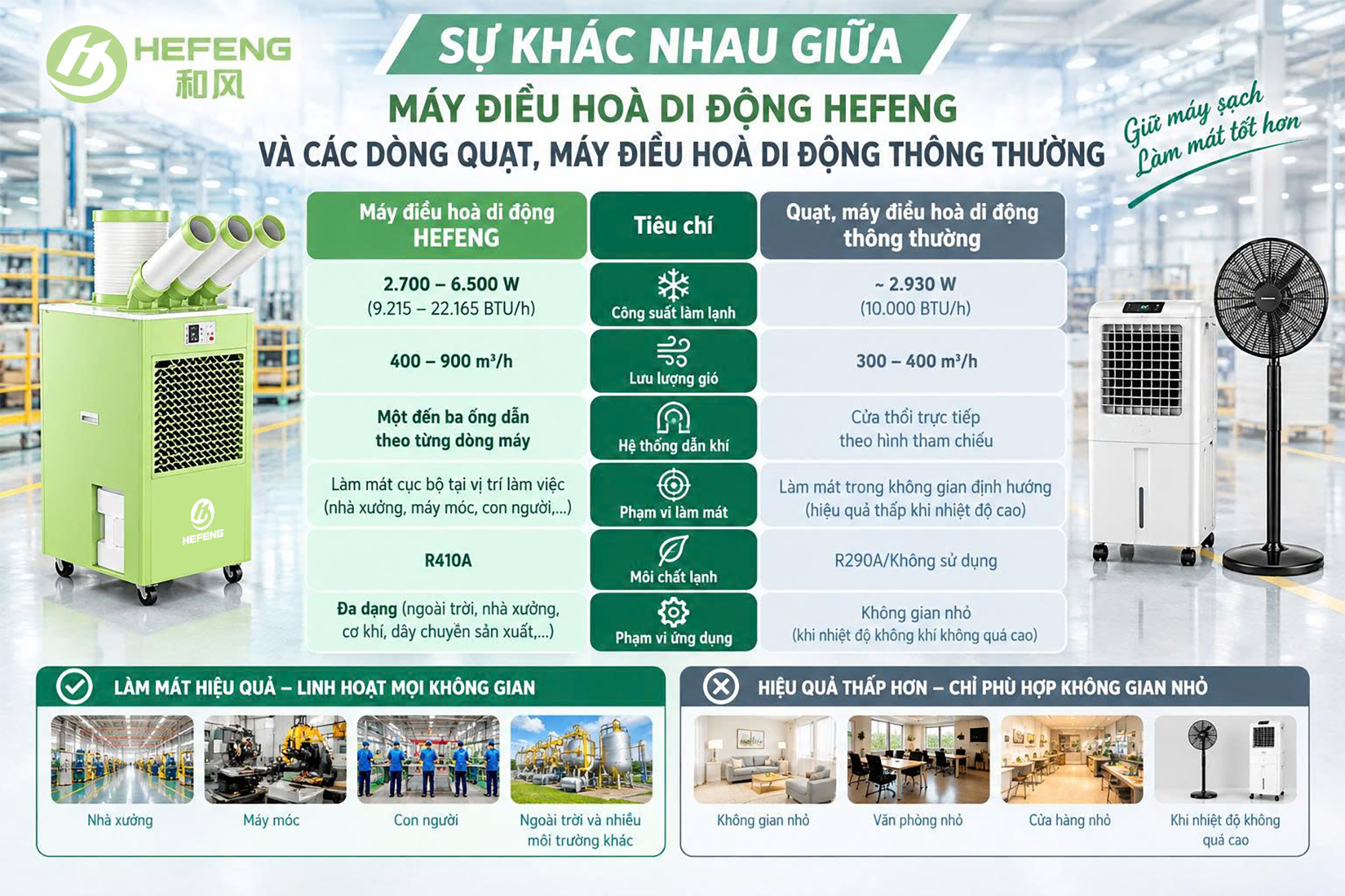
The models include:
- HF-27B: Cooling capacity 2,700 W – 9,215 BTU/h, airflow 400 m³/h.
- HF-40B: Cooling capacity 4,000 W – 13,650 BTU/h, airflow 522 m³/h.
- HF-45S: Cooling capacity 4,500 W – 15,358 BTU/h, airflow 820 m³/h.
- HF-65S: Cooling capacity 6,500 W – 22,165 BTU/h, airflow 900 m³/h.
Cooling capacity reflects how much heat the unit can remove, while airflow indicates the volume of air circulated per unit of time. These two specifications should be considered together when assessing how well a unit meets the cooling needs of each location.
With capacities from 2,700 W to 6,500 W, HEFENG offers options for areas with different cooling requirements. Depending on heat sources, ventilation and equipment layout, businesses can choose a suitable model rather than using a single capacity for every location.
In addition, when combined with the air duct system, HEFENG models help distribute cool air to the areas that need it. This is especially useful in workshops with many independent workstations or where the entire space does not need to be cooled.
This range of capacities lets HEFENG meet spot-cooling needs more flexibly, while making it easier for businesses to choose equipment that fits each use case.
1. A wide range of capacities – Easily find the right model
Every work area has its own characteristics in terms of size, ambient temperature, heat sources and cooling needs. That is why choosing equipment with the right capacity is key to building an effective cooling plan.
Understanding the diverse needs of industrial environments, HEFENG offers four portable air conditioner models with different cooling capacities and airflow rates, giving businesses more options to suit their actual conditions.
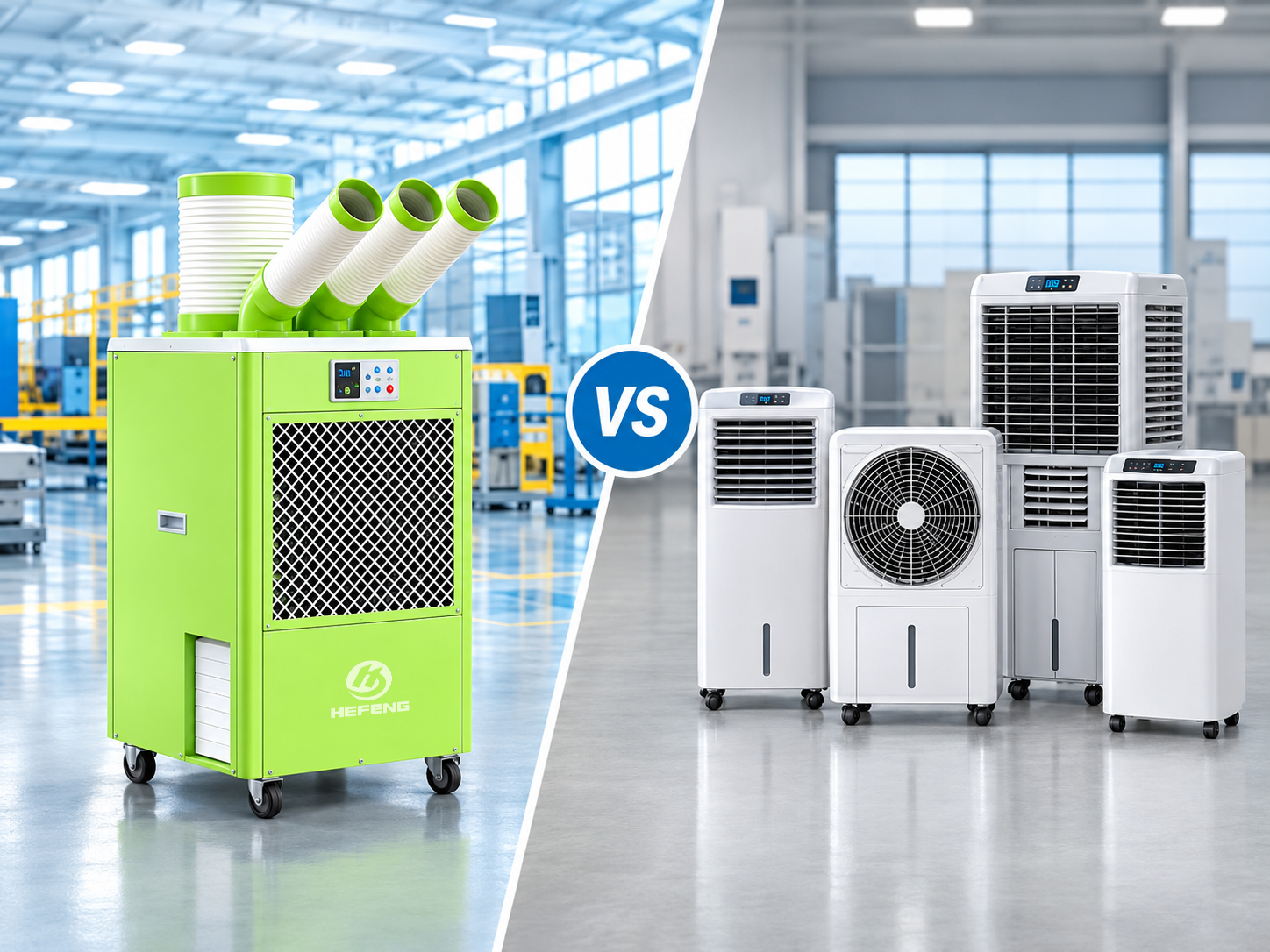
| HEF portable air conditionerENG | Criteria | Conventional fans and portable air conditioners |
| 2,700-6,500 W (9,215 - 22,165 BTU/h) | Cooling capacity | ~ 2,930 W (10,000 BTU/h) |
| 400–900 m³/h | Airflow | 300–400 m³/h |
| One to three ducts depending on the model | Air delivery system | Direct air outlet (see reference image) |
| Spot cooling at the workstation (workshops, machinery, people, …) | Cooling coverage | Directional cooling within a space (less effective at high temperatures) |
| R410A | Refrigerant | R290A / None |
| Diverse (outdoors, workshops, machining, production lines, …) | Applications | Small spaces (when the air temperature is not too high) |
2. Flexible air duct design – Direct cool air where it is needed
One of the standout features of HEFENG portable air conditioners is the air duct system with adjustable air direction, allowing users to direct cool air exactly where they want it.
In production environments, heat is rarely evenly distributed; it may be concentrated around machinery, workbenches, equipment operating areas or stations where workers are continuously present. Cooling the right area therefore becomes an important consideration.
Unlike conventional fans, which mainly blow air in the direction the unit faces, HEFENG portable air conditioners combine cold-air generation with a flexible air duct system. Users can therefore adjust how cool air is distributed to suit their workstations and actual layout.
This design offers several notable benefits:
- Control the cooling direction: Cold air can be directed to the area where it is needed instead of being concentrated in one fixed direction.
- Suitable for many workstations: Can be placed at workbenches, machine operating areas, production lines or individual workstations.
- Flexible when production layouts change: Users can adjust the duct direction to match cooling needs at any given time.
- Supports spot cooling: Delivers cool air to where it is needed without having to cool the entire workshop.
In factories with large floor areas, high ceilings or open spaces, using a fixed air-conditioning system to cool the entire area can face many constraints in terms of layout and investment cost.
In such cases, the HEFENG air duct design offers a more flexible approach that focuses on the cooling needs of each specific location.
This is also one of the reasons HEFENG portable air conditioners are worth considering for businesses that want more control over how they place and use cooling equipment.
3. R410A refrigerant – Effective cooling
Besides capacity and air duct design, cooling technology is another key factor that determines how a portable air conditioner performs.
Unlike conventional fans, which only move air to help the body exchange heat, HEFENG portable air conditioners use a compressor-based refrigeration system with R410A refrigerant to produce air at a lower temperature.
R410A is a refrigerant used in many air-conditioning systems thanks to heat-transfer properties suited to purpose-designed equipment.
During operation, the refrigerant circulates through the system, absorbing and releasing heat. This allows the unit to produce cool air for the area where it is used.
A notable characteristic of R410A is that it is classified in safety group A1 under the ASHRAE 34 standard, meaning it has low toxicity according to the classification criteria and does not propagate flame under standard test conditions.
R290, by contrast, is a group A3 refrigerant and is highly flammable. The two refrigerants therefore have different requirements for system design and safety measures in use.
However, using R410A does not mean absolute safety. Operation, maintenance and refrigerant handling must still follow technical guidelines to keep users safe.
In addition, R410A contains no chlorine and therefore does not deplete the ozone layer, although it still contributes to global warming if released into the environment.
For HEFENG portable air conditioners, combining R410A refrigerant with a compressor and air duct system creates an active cooling solution that works on a different principle from conventional cooling fans.
Actual cooling performance and energy consumption depend on the unit capacity, environmental conditions, placement and how hot exhaust air is vented.
4. Versatile applications in industrial environments
Beyond its multiple capacity levels and flexible air duct system, the HEFENG portable air conditioner can also be considered for many different work areas.
Especially in environments with concentrated heat sources or frequently changing workstations, flexible placement is one of the factors that helps the unit meet real cooling needs.
Factories and production lines
In factories, production lines running continuously can generate considerable heat. Meanwhile, cooling needs are usually concentrated where workers directly operate or monitor equipment.
HEFENG portable air conditioners can be positioned to supply cool air to specific work areas, helping improve temperature conditions for workers.
Machine shops, maintenance and repair areas
Machine shops and machinery maintenance or equipment repair areas often have heat generated by running machines and production activities.
With its mobile design and adjustable air duct system, HEFENG helps direct cool air to workbenches or wherever technicians are working.
This is particularly useful for temporary maintenance work or jobs where the location changes frequently.