HOW TO CLEAN YOUR HEFENG PORTABLE AIR CONDITIONER YOURSELF – NO TECHNICIAN NEEDED
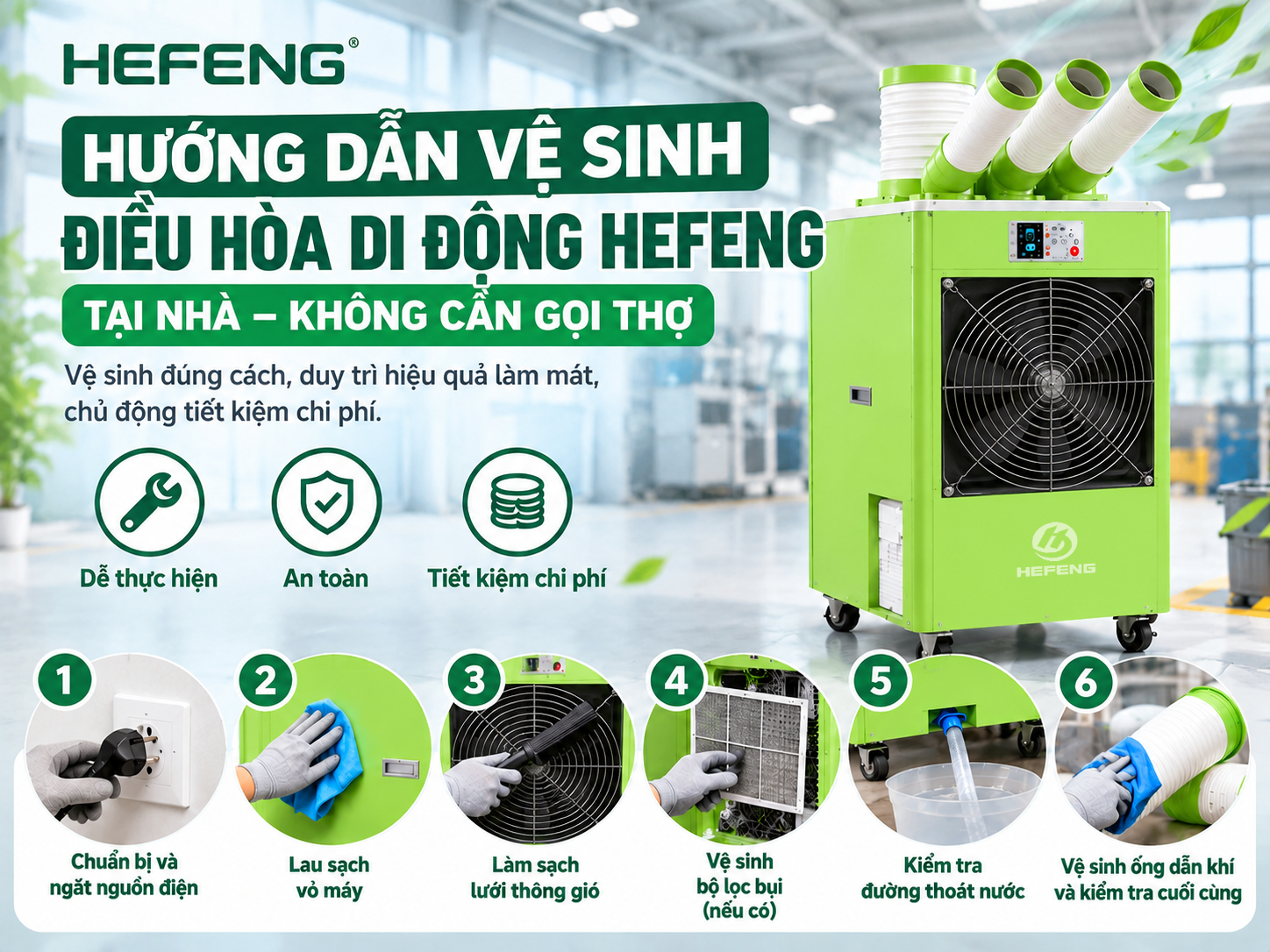
A simple, safe guide to cleaning your HEFENG portable air conditioner yourself, without calling a technician. Learn the steps for cleaning the casing, dust filter and air ducts and checking the drain line to maintain cooling performance, keep the unit running smoothly and save on maintenance costs.
Regular cleaning is one of the key factors that help an air conditioner maintain its cooling capacity and run reliably. However, many users worry that cleaning an air conditioner is complicated, time-consuming and requires a professional technician.
For cooling equipment used in industrial environments in particular, dust can build up faster because of the nature of workshops, production areas or places with many continuously running machines. Without proper inspection and cleaning, dust can obstruct airflow and reduce the cooling performance of the unit.
With HEFENG portable air conditioners, users can carry out many basic cleaning tasks themselves, such as wiping the exterior, cleaning the vents, cleaning removable dust filters and checking the drain line according to the instructions for each model.
These tasks do not require complex specialised tools and can be done without calling a technician, as long as users follow the correct procedure and safety rules.
So how should you clean a HEFENG portable air conditioner properly? What should you keep in mind to avoid affecting the internal components? Find out in the guide below.
1. Preparing to clean your HEFENG portable air conditioner
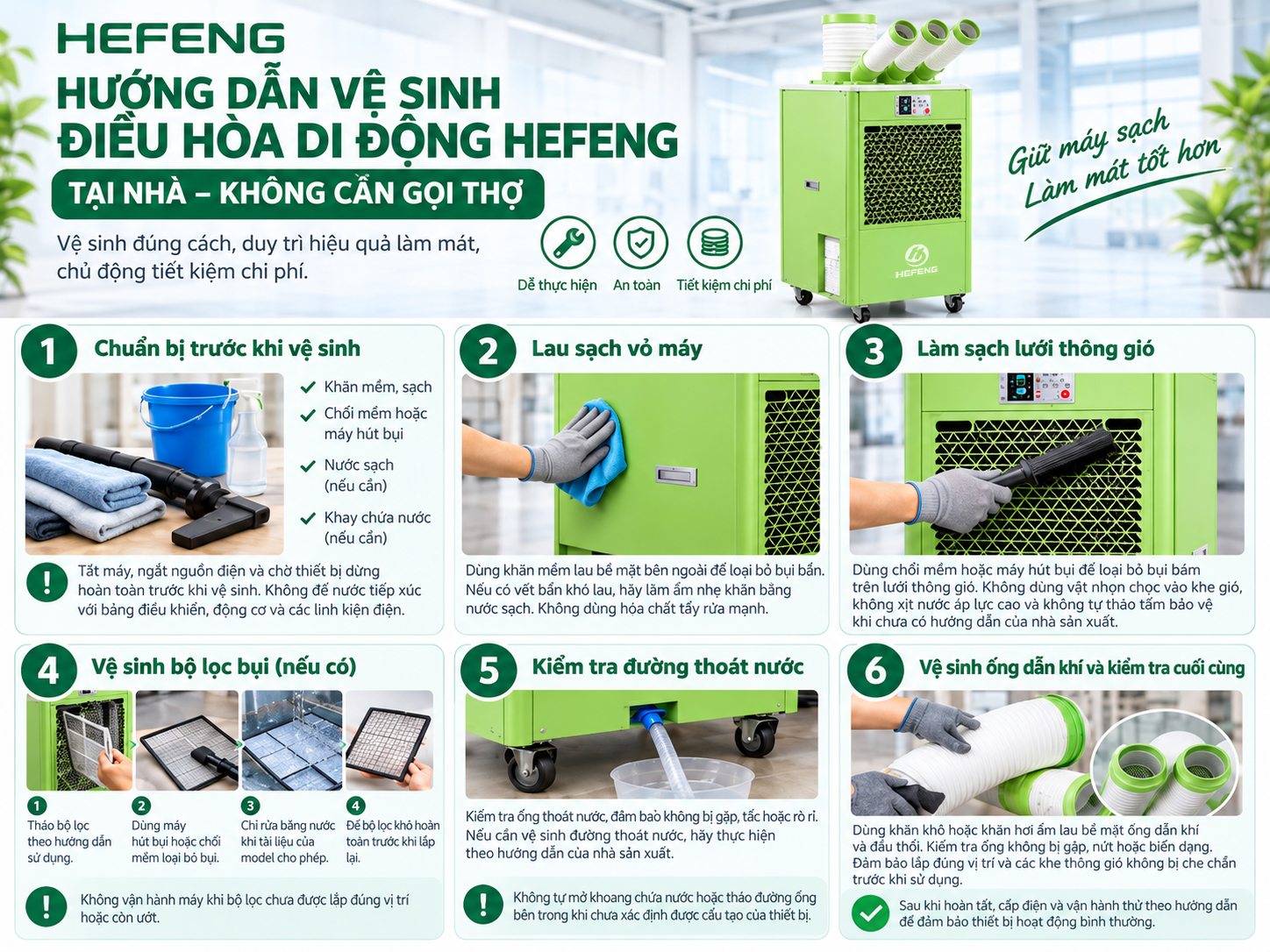
Before you start cleaning, preparing the right tools and checking the condition of the unit will make the process easier and reduce unnecessary risks.
For routine cleaning, users only need a few simple tools:
- Soft, clean cloth: For wiping the casing, the external control panel and other parts that can be reached safely.
- Soft brush or vacuum cleaner: Helps remove dust built up in the vents, filter mesh and spots that are hard to wipe with a cloth.
- Clean water: Use only to dampen the cloth or to clean filters that the manufacturer allows to be washed with water.
- Tray or water container: Use when checking or draining condensate according to the instructions for the unit.
Safety notes before cleaning:
Before doing anything, switch the unit off, disconnect the power supply and wait for it to stop completely. Do not clean the unit while it is still connected to power.
Never spray water directly onto the unit or let water come into contact with the control panel, motor, electrical system or internal components.
Proper preparation not only makes cleaning easier but also helps protect the unit throughout its service life.
2. Step-by-step guide to cleaning your HEFENG portable air conditioner
For basic maintenance, users can clean their HEFENG portable air conditioner by following the steps below. However, the construction and the way some parts are removed may differ between models, so always follow the user manual supplied with the unit first.
Step 1: Wipe the surface and casing
The exterior is constantly exposed to dust during use, especially when the unit is placed in a workshop or production area.
To clean it, gently wipe the entire casing with a soft, clean cloth, removing dust from the housing and any areas that can be reached safely.
For stubborn stains, slightly dampen the cloth with clean water, then wipe again with a dry cloth.
Do not use solvents, harsh cleaning chemicals or abrasive materials, as they may damage the exterior finish of the unit.
Above all, do not spray or pour water directly onto the unit while cleaning.
Step 2: Clean the grilles and vents
The vents play an important role in air circulation through a portable air conditioner.
After a period of operation, dust can collect in the vents and restrict the airflow through the unit. Checking and cleaning these areas is therefore a necessary part of regular maintenance.
Users can use a soft brush or a vacuum cleaner with a suitable nozzle to remove dust from the surface of the vent grilles.
Work gently, and avoid pushing sharp objects deep into the vents or applying force to the protective parts.
Do not use high-pressure water, and do not remove covers or protective parts without instructions from the manufacturer.
Keeping the vents clear supports air circulation and helps the unit operate under suitable conditions.
Step 3: Clean the dust filter if the unit has a removable filter
The dust filter traps part of the dust in the air entering the unit. Over time, dust can accumulate on the filter surface and restrict airflow.
For HEFENG models fitted with a removable filter for cleaning, users can follow this sequence:
1. Refer to the user manual to locate the filter and learn how to remove it correctly.
2. Remove the filter as instructed, without pulling hard or bending the fixed parts.
3. Use a soft brush or vacuum cleaner to remove dust from the surface.
4. Rinse the filter with clean water only if the technical documentation for the model allows it.
5. Let the filter dry completely before refitting it in its original position.
Note: Do not fit a wet filter into the unit, and do not operate the unit unless the filter is installed correctly.
If the filter is torn, deformed or damaged, contact your supplier for advice on inspection and a suitable replacement.
Step 4: Check the condensate drain line
During cooling, the air conditioner may produce condensate when moisture in the air comes into contact with the cold surfaces of the heat exchanger.
Depending on the design of each model, this water may be collected or drained away through a drainage system.
To prevent standing water or leaks, users should check the drain line regularly according to the instructions of the manufacturer.
Points to check include:
- Check whether the drain hose is kinked or pinched.
- Inspect the connections for signs of leakage.
- Make sure the drain line is not blocked by obstructions.
- Drain the condensate exactly as instructed for each model if the unit has this function.
Do not remove internal piping, open the water compartment or tamper with the drainage system unless you fully understand how the unit is built.
If you notice unusual leaks or the drainage system is not working properly, stop using the unit and contact the technical department for an inspection.
Step 5: Clean the air duct system
One of the standout features of HEFENG portable air conditioners is the flexible air duct system, which lets users adjust the airflow direction towards the area that needs cooling.
Because they are constantly exposed to the surrounding environment, the surfaces of the air ducts and outlets can also gather dust after a period of use.
To clean them, gently wipe the outside of the air ducts with a soft cloth, either dry or slightly damp.
For the outlets, use a soft brush to remove dust from easily accessible spots once the unit has been fully disconnected from the power supply.
Besides cleaning, users should also check the condition of the air ducts and make sure no parts are kinked, cracked, deformed or incorrectly fitted.
Do not let water get inside the air ducts or connectors. Only detach the ducts when the manufacturer provides specific instructions.
Keeping the air duct system clean and correctly positioned helps deliver cool air to the area of use.
Step 6: Check the unit before using it again
After completing the cleaning steps, users should check the whole unit before reconnecting the power supply.
Make sure that:
- All parts have been cleaned and are completely dry.
- The dust filter, air ducts and other parts are fitted in the correct positions.
- The power cord and plug show no signs of damage.
- The drain line is not kinked, blocked or leaking.
- The vents are not blocked by any obstructions.
After checking, you can switch the power on and test-run the unit according to the user manual for the model.
During the test run, observe the cooling performance, the airflow coming out and how the unit is operating.
If you notice anything unusual, such as loud noises, a burning smell, water leaks or a clear drop in cooling performance, stop using the unit and contact the technical department for support.
3. How often should you clean your HEFENG portable air conditioner?
Cleaning frequency deserves attention in order to limit dust build-up during use.
However, there is no fixed cleaning interval that suits every unit, as the amount of dust also depends on the working environment, operating hours and actual conditions of use.
Low-dust environments
If the unit is used in a relatively clean area, users can periodically check the casing, vents and filter according to the instructions of the manufacturer.
Clean the unit when dust build-up is noticed or according to the recommended maintenance schedule.
Dusty workshops
In production and machining environments, or areas where dust is frequently generated, the vents and filter can get dirty faster.
Users should therefore inspect and clean the safely accessible parts more often to prevent dust from restricting the airflow.
Areas with fine dust, oil or harsh working conditions
Environments with fine dust, oil vapour or other specific contaminants can cause dirt to stick more firmly to the surfaces of the unit. In such cases, cleaning should follow specific maintenance instructions, and you should consider getting help from a technician if internal parts need cleaning.In general, users should follow the maintenance schedule recommended by the manufacturer and check the unit more often when it operates in very dusty environments.
4. When you should not clean your HEFENG air conditioner yourself
Although many basic cleaning tasks can be done without calling a technician, users still need to distinguish clearly between routine cleaning and in-depth technical maintenance.
Tasks such as wiping the casing, cleaning the vents, cleaning removable filters or checking the outside of the drain line can usually be done by following the user manual.
However, you should not remove or tamper with critical components such as:
- The compressor and refrigeration system components.
- The fan motor and internal electrical parts.
- The control board and wiring.
- The R410A refrigerant piping.
- Heat exchanger assemblies or any parts that require removing the casing to access.
In addition, if the unit shows unusually poor cooling, refrigerant leaks, strange noises, a burning smell or electrical faults, stop operating it and contact a qualified technician.
Disassembling or repairing the unit without the necessary expertise can damage it and pose safety risks.
Users should therefore only carry out the basic cleaning tasks permitted by the manufacturer. For in-depth maintenance, the help of a technician is still necessary.
5. HEFENG – Easy self-cleaning, convenient in everyday use
Besides cooling capacity and flexible placement, ease of cleaning is also an important consideration for portable air conditioners used in industrial environments.
A unit that is properly inspected, cleaned and maintained limits dust build-up, supports air circulation and maintains suitable operating conditions.
With HEFENG portable air conditioners, users can carry out basic cleaning themselves by following the instructions for each model, without having to rely on outside technical services for every simple task.
This brings several practical benefits:
- More control during use: Check and clean external parts whenever necessary.
- Lower basic maintenance costs: Less need to hire services for simple tasks you can safely do yourself.
- Convenient in industrial environments: Easily combine inspection and cleaning with the equipment operating schedule.
- Helps maintain cooling performance: Prevents dust from restricting the airflow.
- Helps protect the unit: Detect unusual signs early during regular inspections.
However, proper cleaning should go hand in hand with technical maintenance as recommended by the manufacturer to ensure the unit operates safely and reliably.
HEFENG – A flexible cooling solution that is easy to use and maintain, suited to cooling needs in workshops and a wide range of working environments.